
Toplotne črpalke: funkcije in prednosti
Izvedite vse o delovanju toplotne črpalke in prednostih.

Table of content
- For quick readers: the most important facts about heat pumps at a glance
- Kaj je toplotna črpalka?
- What is the cost of a heat pump? Costs for purchase and electricity consumption
- Advantages and disadvantages of a heat pump
- Interim conclusion: When is a heat pump really worthwhile? Prerequisites for high efficiency
- Kako deluje toplotna črpalka?
- Katere vrste toplotnih črpalk obstajajo?
- How loud is a heat pump? Test the volume now with the Sound Tool for heat pumps from Bosch.
- Combining a heat pump with photovoltaics
- Heat pumps from Bosch
- FAQ about heating with a heat pump
For quick readers: the most important facts about heat pumps at a glance
- A heat pump heats, produces hot water and cools homes with free environmental energy without the use of fossil fuels.
- Heat pumps are ideal for new buildings; existing buildings must be in good energy condition.
- A heat pump for a single-family home costs around 10,000 to 25,000 euros.
- The necessary operating electricity costs up to 1,000 euros a year and can be significantly reduced with a dedicated photovoltaic system.
- High state subsidies of up to 45% when replacing an old heating system.
- The cost-effectiveness of a heat pump depends on its efficiency, measurable as annual performance factor and COP value.
- Heat pumps work like a refrigerator, only in reverse by means of evaporation, compression, condensation and expansion of a refrigerant.
- There are three main types of heat pump: air-source, ground-source and groundwater heat pumps, each with its own advantages and disadvantages.
- You can easily test the appearance and sound of the popular air-to-water heat pump with the Bosch 3D and Sound Tool.
- Take advantage of the consulting and quotation service, as well as rental and financing models for a wide selection of modern Bosch heat pumps.
Kaj je toplotna črpalka?
Toplotna črpalka je okolju prijazen ogrevalni sistem. Deluje tako, da za ogrevanje uporablja toploto iz okoliškega zraka, zemlje ali podtalnice.
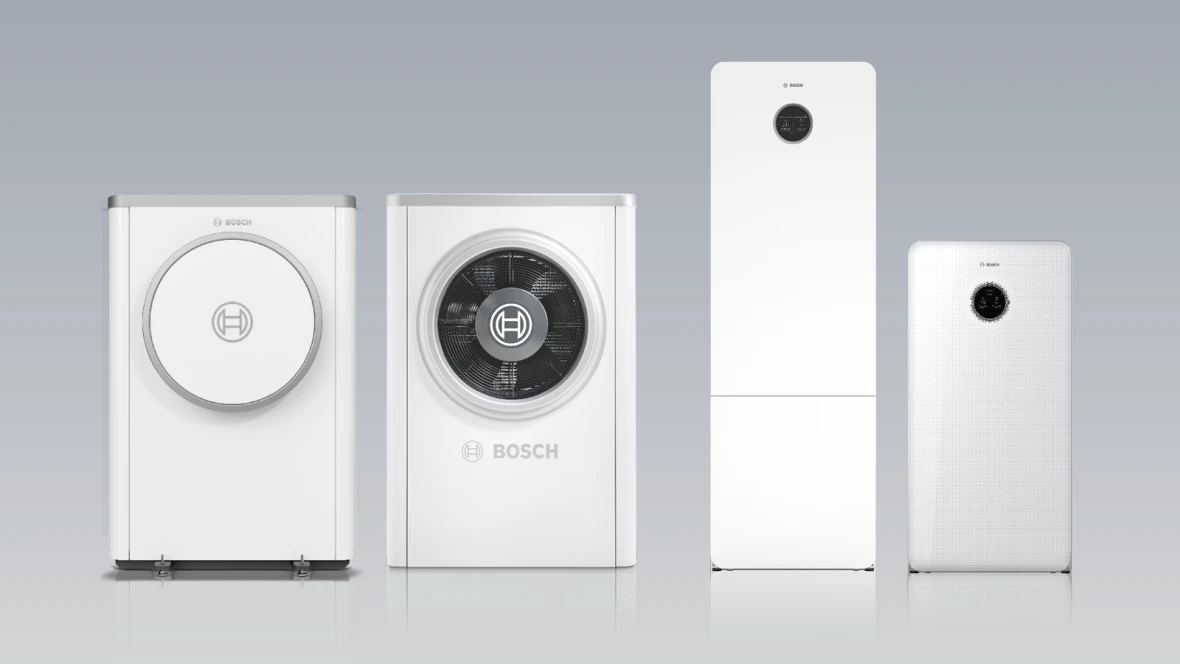
Za razliko od drugih ogrevalnih sistemov – kot so plinski ogrevalni sistemi – je toplotna črpalka zaradi uporabe proste toplote okolice neodvisna od fosilnih goriv. S toplotnimi črpalkami Bosch pa lahko brez težav ogrevate svoj dom skozi vse leto – tudi pozimi. Če se ogrevalni sistem s toplotno črpalko uporablja tudi z zeleno elektriko, je popolnoma klimatsko nevtralen.
Lastniki hiš lahko pogosto zamenjajo zastareli oljni ali plinski grelnik vode z ogrevalnim sistemom s toplotno črpalko po razumni ceni. Dolgoročno to ne varuje le okolja, ampak tudi prihrani denar.
What is the cost of a heat pump? Costs for purchase and electricity consumption
We would like to briefly answer the two most frequently asked questions on the subject here: "What does a heat pump for a single-family home cost?" and "How much electricity does a heat pump consume?". Depending on the heat source, the cost of a heat pump in a single-family house is around 10,000 to 25,000 euros without subsidies. The consumption of a heat pump is up to 5,000 kilowatt hours per year, which accounts for electricity costs of up to about 1,000 euros. Added to this are manageable maintenance costs.
-
Air source heat pump
Acquisition costs 10.500–17.500 Euro Installation costs 4.500–5.500 Euro Development costs none Total price 15.000–23.000 Euro Cost per year** ca. 1.110 Euro -
Geothermal heat pump
Acquisition costs 12.000–14.000 Euro Installation costs 3.500–4.500 Euro Development costs 3.500-5.500 Euro for collector installation*
9.500-11.500 for deep drilling*Total price 15.000-23.000 Euro
19.000-24.000 Euro with ground collectors
25.000-30.000 with earth probesCost per year** ca. 900 Euro -
Groundwater heat pump
Acquisition costs 11.000–14.000 Euro Installation costs 3.500–4.500 Euro Development costs 5.500-8.500 Euro for well drilling Total price 20.000–27.000 Euro Cost per year** ca. 800 Euro
* For boreholes, the cost is 50 to 60 euros per meter drilled; for collector installation, the cost is approximately 40 to 50 euros per meter buried.
** The consumption costs are an average value. Basis is a typical single-family house with 120 m² living space, total heat demand 20,000 kWh per year, electricity price for the heat pump 20 cents / kWh.
If a heat pump is to be combined with photovoltaics, the additional costs amount to approx. 10,000 euros. Read our advice articles on gas heating alternatives and oil heating alternatives to find out what costs arise when you convert a gas heating system or oil heating system to a heat pump.
Request an offer without obligation! >
Advantages and disadvantages of a heat pump
Prednosti toplotnih črpalk
- toplotne črpalke zanesljivo izpolnjujejo potrebe po ogrevanju in topli vodi;
preprosto vzdrževanje; - so okoljsko in podnebno sprejemljive;
- toplotne črpalke, ki delujejo na zeleno električno energijo (fotonapetost), so CO2-nevtralne;
- stroški nakupa se povrnejo z nizkimi obratovalnimi stroški;
- v novogradnjah dimniki niso potrebni;
- toplotne črpalke omogočajo aktivno ali pasivno hlajenje poleti;
- toplotna črpalka povečuje lastno porabo in donosnost fotonapetostnih sistemov.
Disadvantages of a heat pump
- Sensitive heating system that must be individually adapted to a building
- Comparatively high investment costs and high planning effort
- Additional development costs and earthworks for an earth or groundwater heat pump
- For retrofitting in old buildings, a good building fabric is a prerequisite
- Radiators often need to be refurbished before installation
- Backup system may be required for particularly cold days (electric heater)
- Increased electricity costs with incorrect planning
- Electricity prices for heat pump power are not exempt from general price increases
- Photovoltaic system for own power supply costs additionally
- Air-source heat pumps can be acoustically disturbing if they are not soundproofed.
Interim conclusion: When is a heat pump really worthwhile? Prerequisites for high efficiency
Unlike pellet or gas heating, a heat pump is a sensitive heating system. The technology has fewer reserves if more heating power is unexpectedly required, for which the heat pump was not originally designed. Whether heating with environmental heat is worthwhile is closely related to the efficiency of a heat pump. If the right conditions are met, as in the case of a new building or energy-efficient old building, the heat pump heats very efficiently and enables permanently low operating costs.
From a technical point of view, the efficiency of a heat pump is related to the following parameters:
-
Low flow temperatures
The flow temperature for the heating surfaces is central to finding out whether a heat pump is suitable for your house. A constant 35 °C in the flow is ideal. This requires good insulation and high-quality surface heating, such as wall or floor heating. If the flow temperature is much higher than 45 °C, the efficiency of the heat pump drops and energy costs rise.
-
High COP value
The "Coefficient of Performance" stands for the performance of a heat pump under laboratory conditions and can often be found in product documentation. A heat pump with a COP value of 3.1 to 5.1 is considered efficient and economical. If the value is shown as SCOP, the informative value is even higher, since seasonal changes in heating demand are also included.
-
High annual performance factor
In contrast to the COP, the annual performance factor (APF) stands for the efficiency of a heat pump in real operation. The higher the COP, the more efficiently the heat pump operates. Air-source heat pumps achieve an COP of up to approx. 3.5; ground-source heat pumps up to approx. 4.5 and groundwater heat pumps up to approx. 5.0. With an annual performance factor of 4.0, the unit provides the heat required for heating and hot water from one part electricity and three parts environmental energy.
Bosch - Your strong partner for heat pumps
- Outstanding innovative strength
- High quality and safety standards
- 5-year system warranty
- Over 100 years of expertise in thermotechnology
- Attractive subsidy opportunities
- Bosch is your smart partner for environmentally friendly and efficient heating systems.
Kako deluje toplotna črpalka?
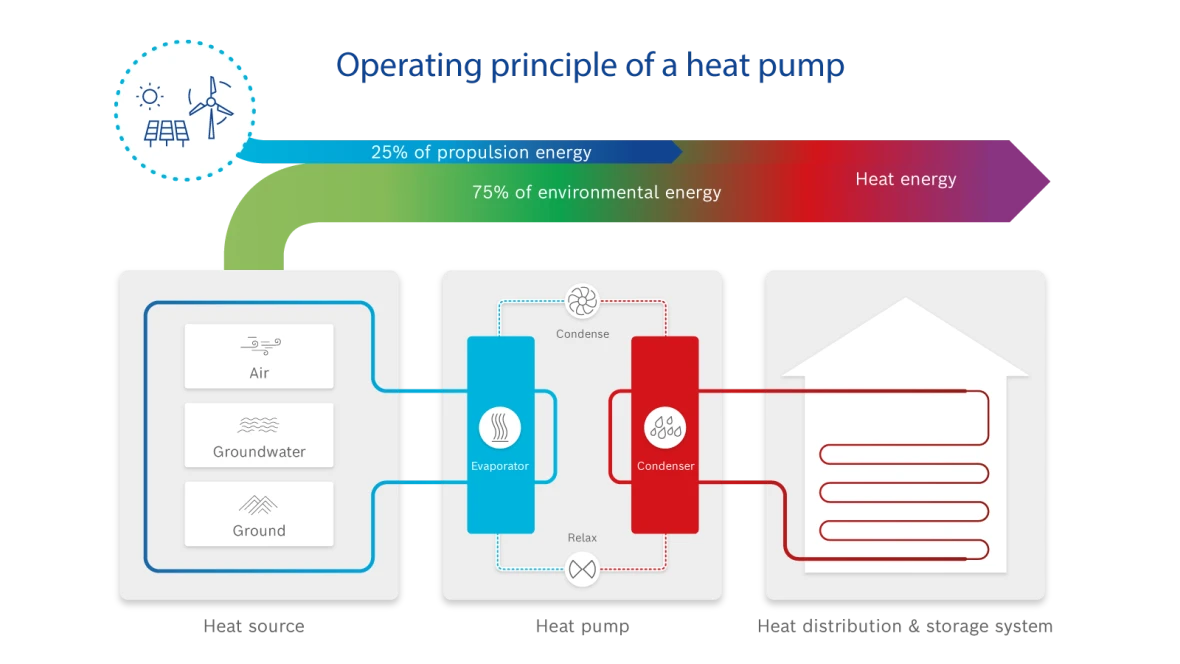
Kako toplotne črpalke proizvajajo ogrevalno energijo z nizko porabo električne energije? Trik je preprost: funkcija toplotne črpalke je takšna, da odvzame toplotno energijo iz okolja (zrak, zemlja, voda) in jo prenese v vaše bivalne prostore.
Zračna toplotna črpalka deluje obratno od hladilnika. Ko se hladilnik ohladi, se toplota proizvaja kot »odpadek«. Ta toplota se prenese z zadnje strani naprave v okoliški zrak. Enak proces poteka v zračni toplotni črpalki, vendar v nasprotni smeri: vzame toploto iz zraka, ki obdaja enoto, nameščeno zunaj vašega doma, in jo kot toplotno energijo prenaša v vaš ogrevalni sistem. Medtem ko se vaš ogrevalni sistem segreva, se zrak, ki prehaja skozi enoto, ohlaja. Vse, kar je potrebno za ta proces, je elektrika.
Katere vrste toplotnih črpalk obstajajo?
Toplotna črpalka je v osnovi na voljo v treh vrstah: zrak-voda, zemlja-voda in voda-voda. Toplotne črpalke zrak voda so pri nas daleč najbolj iskane naprave, saj jih je najenostavneje namestiti. Pri toplotnih črpalkah zrak-zrak in sanitarna voda obstajajo še druge »posebne oblike«, ki se uporabljajo za posebne namene. Z naslednjo primerjavo vam želimo dati prvi vtis, katera toplotna črpalka je morda najboljša za vašo hišo.
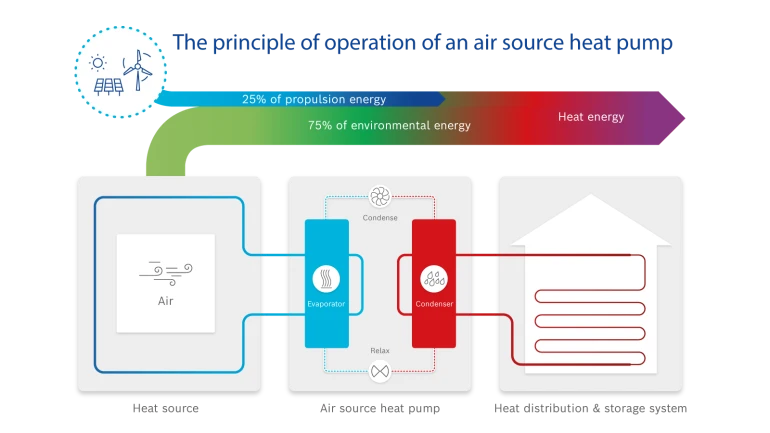
Toplotne črpalke zrak-voda
Uporaba toplote: iz okoliškega zraka
Uporaba: Ogrevanje, topla voda, hlajenje v starih in novogradnjah.
Prednosti: ni potrebna ali zahteva minimalna površina; možna zunanja ali notranja namestitev; potrebna minimalna gradnja brez zemeljskih del; brez dovolilnice; cenejša od drugih toplotnih črpalk; lahko deluje v kombinaciji s sončno energijo, plinom ali oljem
Slabosti: Izkoristek/letni izkoristek nekoliko nižji v primerjavi z drugimi toplotnimi črpalkami
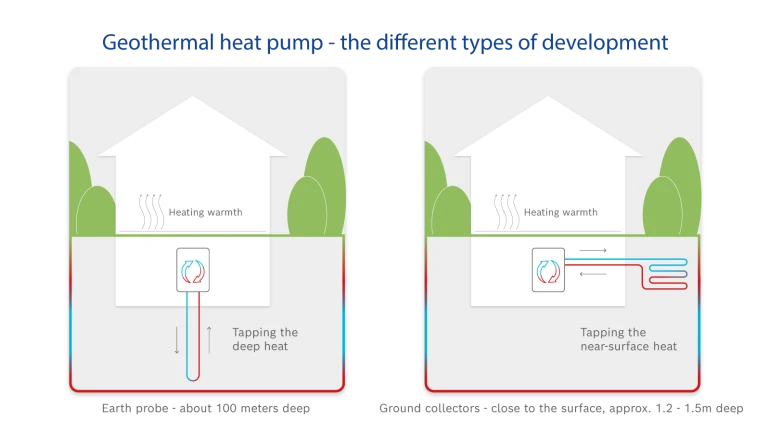
Geotermalne toplotne črpalke (zemlja-voda)
Vir toplote: zemlja (pripovršinska geotermalna energija z velikimi zemeljskimi kolektorji do globine 2 m ali globoka geotermalna energija z zemeljskimi sondami do globine 100 m).
Uporaba: Ogrevanje, topla voda, hlajenje v starih hišah in novogradnjah.
Prednosti: Visoka celoletna učinkovitost zaradi stalne temperature tal; neodvisen od temperature zraka; brez vidne zunanje opreme; nizki obratovalni stroški
Slabosti: V primerjavi z drugimi toplotnimi črpalkami višji začetni stroški in visoki stroški gradnje zaradi zemeljskih del; potrebno dovoljenje
Further information: Advice article on brine-to-water heat pumps.
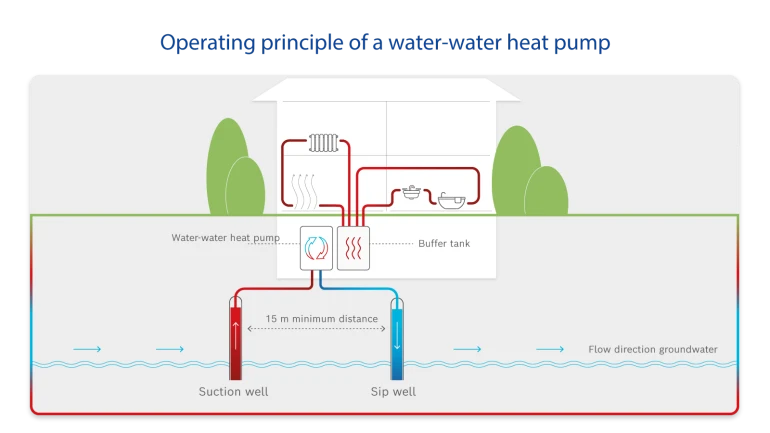
Water-water heat pumps
Heat source: ground (near-surface geothermal with large-scale ground collectors up to 2 m deep or deep geothermal with ground probes up to 100 m deep).
Use: Heating, hot water, cooling in old and new buildings.
Advantages: High efficiency year-round due to constant ground temperatures; independent of air temperatures; no visible outdoor equipment; low operating costs; hybrid with solar
Disadvantages: Compared to other heat pumps, higher initial costs and high construction costs due to earthwork or deep drilling; medium-size lot required; permit required
Further information: Advice article on brine-to-water heat pumps.
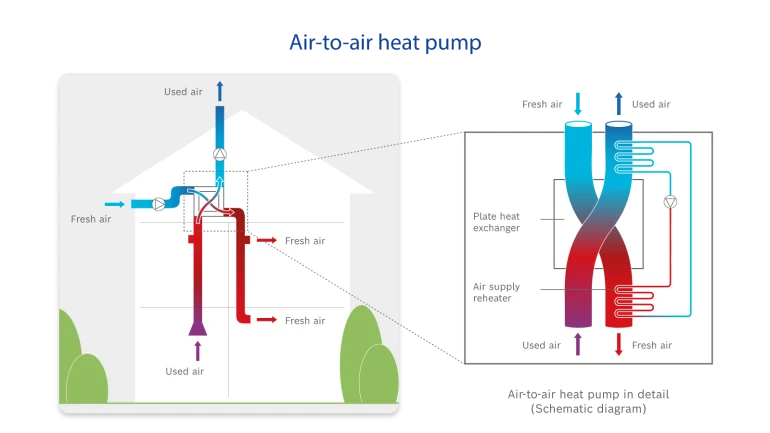
Air-to-air heat pumps
Heat source: exhaust air from indoor spaces
Application: Heat recovery for ventilation systems / air heaters of low-energy and passive houses (new construction).
Advantages: Ideal supplement for ventilation systems for space heating; air conditioning possible; can be combined with photovoltaics
Disadvantages: Only relevant for ventilation heating systems in high-efficiency new buildings; unsuitable for old buildings; no water heating; less efficient than other heat pumps; higher maintenance requirements
More information: Advice article on air-to-air heat pumps.
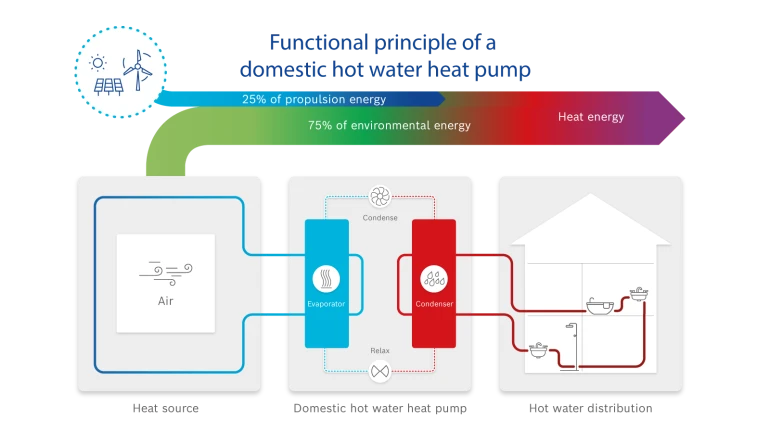
Domestic hot water heat pumps
Heat source: waste heat from technical equipment indoors (indoor air).
Use: Hot water in old and new buildings
Advantages: Taps unused, cost-free waste heat for water heating; low initial cost; easy installation; high efficiency; small footprint; can be combined with almost all heating systems
Disadvantages: Unsuitable for residential heating and air conditioning; waste heat in boiler room, server room, etc., must be constant year-round
Further information: Guide article on domestic hot water heat pumps.
How loud is a heat pump? Test the volume now with the Sound Tool for heat pumps from Bosch.
Supposed noise in the outdoor area of residential buildings is an issue with heat pumps. However, only air-to-water heat pumps are affected. The devices draw in ambient air with the help of a fan, which causes perceptible operating noise. Ground-source and groundwater heat pumps, on the other hand, operate completely silently outdoors.
In order to assess the loudness of an air-to-water heat pump, it is important to distinguish between sound power level (noise generated directly by the heat pump) and sound pressure level (perceptible noise at a normal distance). Bosch sound-optimized heat pumps achieve peak sound pressure levels of less than 40 decibels (like rustling leaves) and can be used in tightly built-up residential areas.
You can use the Bosch sound tool to test the sound levels of our current air-to-water heat pumps. For more information, such as the appropriate installation location and distances to neighboring properties, see our guide article on heat pump sound levels.
Combining a heat pump with photovoltaics
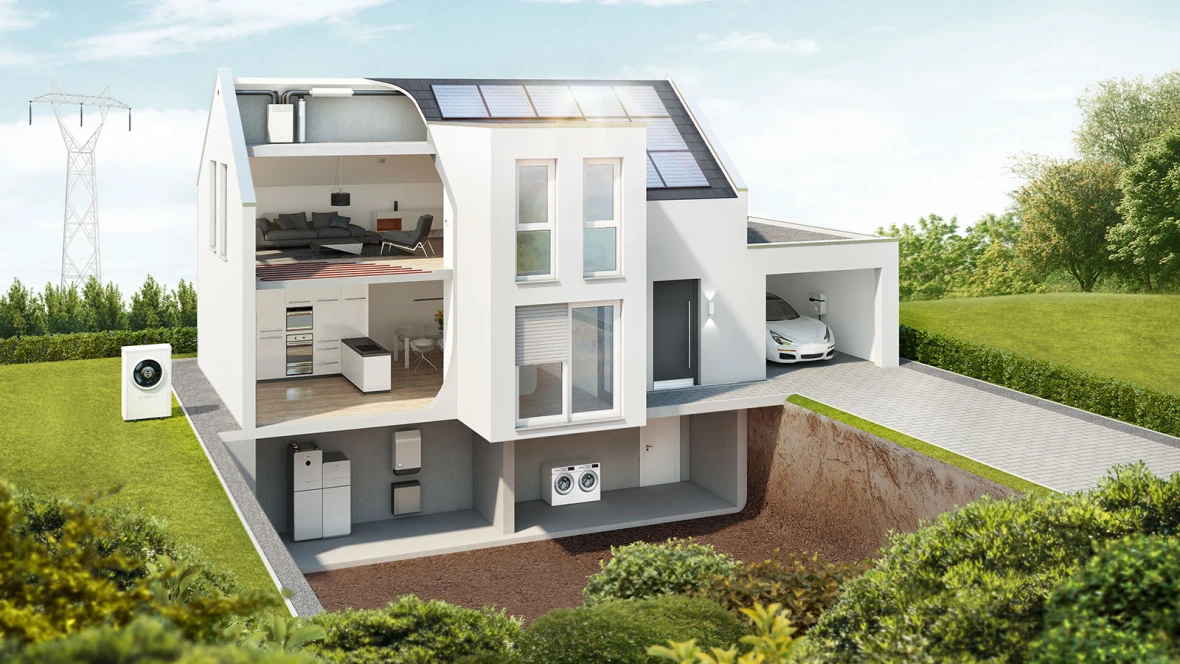
Photovoltaics is an ideal complement for a heat pump in a single-family home. You can generate most of the electricity required for the heat pump yourself with the photovoltaic system, which minimizes electricity costs in the long term and makes you less dependent on energy suppliers and rising electricity prices. In addition, the solar power can also be used in the household.
Optimal interaction between solar and heat pump is ensured by an electricity storage system and the intelligent distribution of solar power in the house. In a hybrid heat pump from Bosch, this task is performed by the Bosch Energy Manager. The smart tool regulates all power flows in the house fully automatically and optimally adapts the operating times of the heat pump to the availability of self-produced electricity. This saves a lot of electricity from the grid and significantly increases your independence.
Heat pumps from Bosch
At Bosch, you'll find a wide selection of innovative heat pumps for single-family homes as well as duplexes and apartment buildings. Our product range includes air-to-water heat pumps, brine-to-water heat pumps, and domestic hot water heat pumps. With a Bosch heat pump, you can easily supply your home with heat and hot water and benefit from the high quality and reliability of our products.
-
High-efficiency heat pump technology that saves on heating costs
-
Whisper-quiet air-source heat pumps through consistent sound optimization
-
The right heat pump for every output: air-source heat pumps from 2-56 kW, ground-source heat pumps from 2-78 kW
-
Hybrid capable with solar, gas or oil
-
Innovative use of solar power with the Bosch Energy Manager
-
Easy operation via color touch display, remote control or app
-
Easy integration of the heat pump into a smart home system
-
Attractive design
-
5 years warranty
FAQ about heating with a heat pump
Najden je bil rezultat za »«
Najdenih je bilo rezultatov za »«
How long does a heat pump last?
How long does a heat pump last?
Heat pumps are designed to last 20 years or more. Ground and groundwater heat pumps have the advantage that ground collectors, geothermal probes or wells can even outlast the lifetime of the heat pump unit and continue to be used. This is demonstrated by examples such as the repowering of this 43-year-old heat pump.
My house has radiators. Does it still make sense to install a heat pump?
My house has radiators. Does it still make sense to install a heat pump?
Installation is possible, but it remains questionable whether it makes sense. The heat pump might have to be operated at a high flow temperature, or the radiators would have to be large enough to warm the house. You can find out whether the radiators in your house are suitable for a heat pump during an individual consultation with your Bosch heating expert. Just get in touch with us!
What is the EVU interruption for a heat pump all about?
What is the EVU interruption for a heat pump all about?
If heat pumps purchase discounted heat pump electricity, the responsible grid operator is entitled to interrupt electricity purchases at peak load times. For more information, see our guide article on the disconnection of heat pumps by the utility company.
Heat pump or condensing technology: Which is more economical?
Heat pump or condensing technology: Which is more economical?
Although the initial cost of a heat pump at around 10,000 to 25,000 euros is significantly higher than that of an oil or gas heating system at around 10,000 euros, the heat pump usually pays for itself after around 10 to 15 years. The reasons are the high state subsidies and the lower operating costs for electricity consumption - in contrast to fluctuating oil and gas prices and rising CO2 taxes. For more information, see our advice article on heat pumps or gas heating.
Does a heat pump with photovoltaics receive additional government funding?
Does a heat pump with photovoltaics receive additional government funding?
No, photovoltaics are not eligible for subsidies to the same extent as a heat pump. A direct subsidy is not possible for a photovoltaic system, however, depending on the federal state, you can receive a subsidy for the electricity storage. In addition, the feeding of solar power into the public grid is still remunerated with a few cents per kilowatt hour. Regardless of this, heat pumps receive the full state subsidy via the federal subsidy for efficient buildings.
How often is maintenance necessary for a heat pump and what are the maintenance costs?
How often is maintenance necessary for a heat pump and what are the maintenance costs?
Due to their simple design, heat pumps are more robust than many other heating devices. For safe and efficient operation, we recommend heat pump service once a year. The costs for the maintenance of a heat pump start at about 150 euros.