
Domestic hot water heat pump: hot water for your home
Why use precious energy to generate hot water when you can simply use existing waste heat for this purpose? A domestic hot water heat pump or hot water heat pump makes exactly that possible. Read here under which conditions it is really worthwhile for your wallet and the environment to generate hot water with a heat pump!

Table of contents
- What is a domestic hot water heat pump?
- Is a domestic hot water heat pump the same as a hot water heat pump?
- How does a hot water heat pump work?
- Hot water heat pump operate hybrid with solar
- What to consider when buying a domestic hot water heat pump?
- Retrofit and install domestic hot water heat pump
- Hot water temperature of the heat pump: degree numbers and setting
- Domestic hot water heat pump: advantages and disadvantages
- You can expect these costs for hot water heat pumps
- Are there any subsidies for a hot water heat pump?
- FAQ about the heat pump for hot water or domestic hot water
What is a domestic hot water heat pump?
A hot water heat pump, also known as a domestic hot water heat pump, is used specifically for heating water - for example, for rinse, bath and shower water and for heating drinking water for fresh water. It works similarly to an air-source heat pump. However, there are two important differences between hot water and air-source heat pumps:
- Air-source heat pumps are full-fledged heaters, i.e. they are used as heat pumps for heating and hot water. Domestic hot water heat pumps serve only as heat generators for the hot water system. Since the heat pump is only responsible for hot water, the units have a much lower output and are smaller in size.
- An air-source heat pump uses the energy of the outside air to heat the living space. In contrast, a domestic hot water heat pump usually uses the warm air inside the building as its energy source, for example, the waste heat in the boiler room, the exhaust air from a ventilation system, or where electronic appliances such as a freezer, washing machine, and dryer are located. Alternatively, hot water heat pumps can also use the outside air.
Is a domestic hot water heat pump the same as a hot water heat pump?
The terms hot water heat pump and domestic hot water heat pump mean the same thing, just expressed differently. Rather rarely, the synonym domestic hot water heat pump is also used. With the help of ambient air is heated hot water, which is used for showering, washing or even cooking. So, heat pumps for domestic hot water is the water that is "used" and "consumed" by you. This drinking water or hot water for heat pumps should not be confused with the heating water in the closed system, which is also called service water. However, you cannot use domestic hot water heat pumps or hot water heat pumps to heat your home. If you are interested in a heat pump for heating and hot water in one unit, learn more in our guide article about the heat pump as a heating solution.
How does a hot water heat pump work?
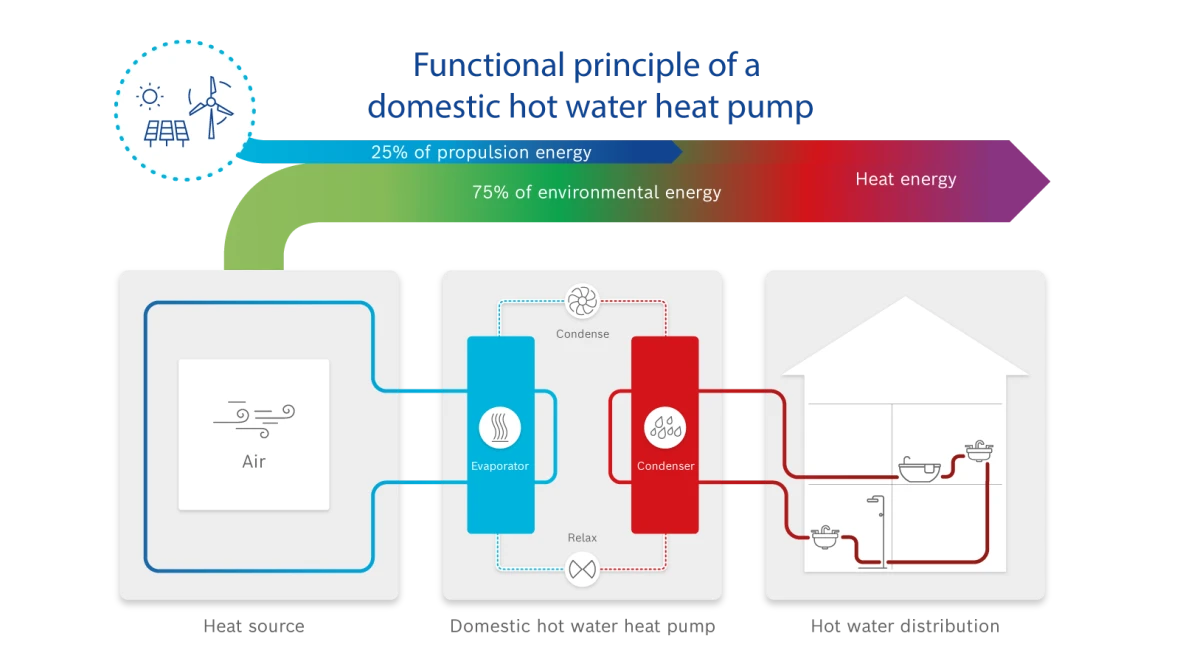
Produce hot water with a heat pump by extracting heat from recirculated air, exhaust air or outside air: Apart from a few differences, the operation of a domestic hot water heat pump is very similar to that of an air-to-water heat pump heating system. Warm air is taken in, cooled, and in the process transfers energy to a refrigeration cycle including refrigerant. A compressor raises the temperature by compression. A heat exchanger transfers the heat to another system, in this case the hot water tank built into the heat pump. The hot water is then distributed to the taps in the rooms, but not to the radiators. A domestic hot water heat pump with heating support is not possible. The pumps and compressors consume electricity during this process. The most favorable installation site for a hot water heat pump is therefore where a lot of heat is generated, for example in the boiler room or from the exhaust air of an existing ventilation system. The more waste heat that can be used, the less electricity is needed for the process. This also increases the efficiency of the hot water heat pump.
Hot water heat pump operate hybrid with solar
In monovalent operation, a heat pump is the sole heat source; in bivalent operation, it is combined with another heat source. Heat pumps for hot water are ideally designed for solar use. In combination with a solar system, a hot water heat pump works particularly efficiently. This is also referred to as a solar heat pump. With a hybrid system of domestic hot water heat pump with solar thermal or photovoltaic, you can use 100 percent renewable energy. In this case, the hot water is provided by the free solar energy and not solely by the heat pump, which is powered by electricity. A hybrid-capable control system takes care of switching the components on and off. In addition, with the connection of a PV system, self-generated electricity can be provided for the heat pump, thus reducing the share of grid electricity. Connection to a ventilation system is also conceivable. The powerful hot water heat pumps from Bosch can be easily and flexibly combined with heating, solar thermal or photovoltaic systems.
What to consider when buying a domestic hot water heat pump?
Clarify professionally in advance whether a heat pump for hot water makes sense for your situation on site. A hot water generator such as the domestic hot water heat pump is worthwhile, for example, in old buildings to support the existing heating system. But it also uses the waste heat from electrical appliances, heating systems or the exhaust air of a ventilation system in new buildings.
How useful is a hot water heat pump?
Basically, a domestic hot water heat pump is a sensible addition to your house to save energy and costs and to relieve the environment by using renewable energies for the hot water supply. Another advantage is that the hot water heat pump dehumidifies the installation room and thus prevents mold growth.
Two criteria play a special role in ensuring that you derive ecological and financial benefit from the purchase of a hot water heat pump.
- Conditions at the installation site: There should be regular waste heat that can be used as a heat source for hot water. Boilers in which energy sources are burned are predestined for this. Installation in basement rooms is therefore recommended.
- Integration of other systems: By combining a hot water heat pump with photovoltaics, you can effectively increase the degree of self-consumption of the system. So if a solar system is available or planned, the domestic hot water heat pump can be a logical addition to it. The connection to an air distribution system is also worthwhile.
The space requirement and noise development of a domestic hot water heat pump are low. The noise level indoors is usually around 50 dB(A), which is similar to the quiet hum of a refrigerator. Factors such as insulation standard and energy efficiency of the building do not play a special role, because the heat pump is not intended to heat the building. Therefore, it does not matter that the oefficient of performance COP of a domestic hot water heat pump is often lower than that of other heat pumps.
If you have any questions about purchasing a domestic hot water heat pump and would like more information, such as a sound cost-benefit calculation that looks at the entire heating and hot water system and also at generating your own electricity, it is best to contact a Bosch partner near you.

Retrofit and install domestic hot water heat pump
If you want to retrofit a domestic hot water heat pump, you can easily expand the existing system with it and without taking up a lot of space. The installation of a domestic hot water heat pump is relatively simple. Nevertheless, the device may only be installed by an authorized specialist company and not by oneself, as applicable regulations must be observed. The technician must connect the hot water heat pump to the water pipes and to the electricity. In the course of this, a separate circuit must be installed, which is responsible only for the heat pump. Retrofitting a hot water heat pump is particularly worthwhile in existing buildings that are heated by fossil fuels. Since the domestic hot water heat pump operates independently of the existing heating system, no gas or oil is used to heat water, which saves money and protects the environment. However, the device must be precisely matched to the hot water demand so that it can achieve its maximum efficiency. The specialist determines this reliably and accurately.
Good to know:
Since many conditions play a role, some tact and experience is required when planning a heat pump for domestic hot water. In direct comparison, for example, an instantaneous water heater, but also a central hot water tank for heat pumps is easier to plan accurately. But under the right circumstances, a correctly planned domestic hot water heat pump can drastically reduce your hot water costs through waste heat recovery. Compared to heating water via the heating system, savings of up to 70 percent are possible with a domestic hot water heat pump!
Hot water temperature of the heat pump: degree numbers and setting
A decisive factor in a heat pump for hot water is the temperature of the domestic water. How many degrees the device can provide depends on the model and its performance. In principle, heat pumps can produce hot water up to around 60 degrees. Domestic hot water heat pumps are designed specifically for the production of hot water and, accordingly, ensure a high level of hot water comfort. It is not possible and not necessary to produce hot water above 100 degrees with a heat pump.
The Bosch Compress 5000 DW hot water heat pump has a factory-set water temperature of 55 degrees, but this can be adjusted to the desired hot water temperature as desired. During operation of the device, temperatures can exceed 60 degrees. You can set the hot water temperature on the heat pump from a minimum of 30 degrees to a maximum water temperature of 65 degrees, and even 75 degrees is possible with an electric auxiliary heater. When connecting to external equipment (e.g. a solar controller), the maximum temperature of the domestic hot water heat pump must not exceed 80 degrees to avoid equipment damage. For this case, there is an integrated temperature protection of the water tank, which automatically kicks in. A time program on a hot water heat pump can be useful to minimize the so-called heat losses. This means how much heat the hot water tank loses at a certain water temperature.
Domestic hot water heat pump: advantages and disadvantages
| Advantages | Disadvantages |
|---|---|
|
|
Buy Bosch hot water heat pump
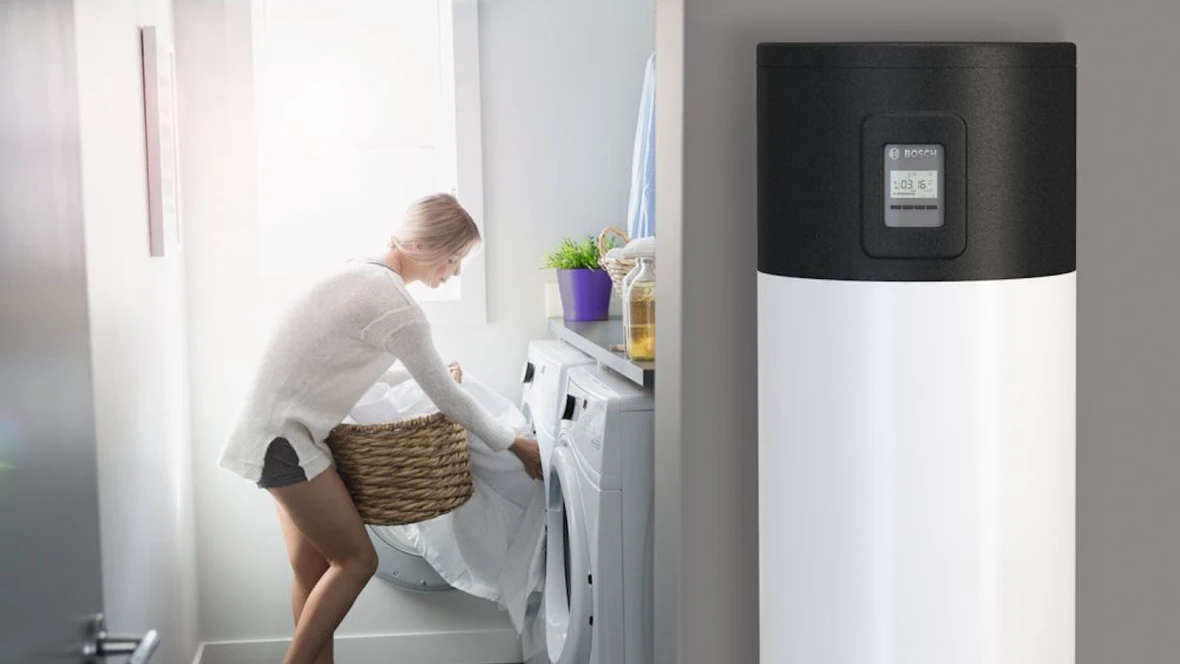
Looking for a domestic hot water heat pump with a 200 to 300 liter hot water storage tank for indoor installation? The new Bosch heat pump for hot water is available in two cylinder sizes of 200 liters and 260 liters and is ideally designed for single-family homes - both for modernization and new construction. The Bosch hot water heat pump provides high hot water comfort with temperatures up to 65 degrees in heat pump-only mode. Thanks to an electric heat exchanger, the heat pump even manages hot water temperatures of up to 75 degrees. The booster function enables rapid heating if you need a lot of water in a short time.
Compress 500 DW
- Hot water heat pump for domestic hot water and drinking water
- Easy and flexible combination with heating, solar and photovoltaic system
- 200 or 260 liter storage volume - also suitable for larger households
- Simple operation via display
The Bosch heat pump with water heating is ideal for energy recovery from warm exhaust air and for drying damp rooms. The indoor unit allows flexible installation and maintenance. It is also practical that you can adjust the settings for the hot water heat pump via the display according to your individual needs. Thanks to the integrated Bosch hot water tank with heat pump, you can easily supply your household with hot water all year round. In the process, you benefit from free heat from the environment and save energy.
You can expect these costs for hot water heat pumps
The price of a domestic hot water heat pump is around 3,000 euros. By comparison, heat pumps for heating and hot water cost around 15,000 to 30,000 euros. In addition to the purchase, the installation of hot water heaters costs around 350 euros. The costs for the ongoing operation of a domestic hot water heat pump consist of the electricity consumption and very manageable maintenance costs of the heat pump. A purchase is worthwhile for you especially if the annual electricity costs are lower than what you pay for oil or gas, for example.

How much electricity does a hot water heat pump consume per year?
The electricity consumption of a hot water heat pump basically depends on the quantity and temperature of the domestic water. For example: for a household with four people and an average daily hot water consumption of 40 liters per person, we assume an annual electricity consumption for hot water production of 2,000 kWh. At an electricity price of 30 cents per kWh, this results in an annual electricity price of approximately 600 euros with a hot water heat pump.
However, the more efficient the heat pump, i.e. the higher your annual performance factor, the lower the electricity consumption of heat pumps. For a solid annual performance factor, high-quality equipment, expert installation and a good heat supply in the installation room are the most important factors.
Are there any subsidies for a hot water heat pump?

Direct individual subsidies for domestic hot water heat pumps are not currently granted. Nevertheless, domestic hot water heat pumps can receive government funding as part of a package of measures for modernizing the heating system. Subsidies are available for consulting, planning and acquisition costs, as well as installation.
FAQ about the heat pump for hot water or domestic hot water
Najden je bil rezultat za »«
Najdenih je bilo rezultatov za »«
Can a heat pump also provide hot water in the house?
Can a heat pump also provide hot water in the house?
Yes, you have two options when supplying hot water with a heat pump. Either you choose an external or internal hot water solution. A heat pump heating system heats the living spaces and simultaneously provides hot water via a separate storage tank. Alternatively, a domestic hot water heat pump with integrated storage tank can be installed as a supplement to the existing heating system, specifically providing hot water by using existing waste heat.
Ist eine Wärmepumpe für Warmwasser sinnvoll?
Ist eine Wärmepumpe für Warmwasser sinnvoll?
Yes, a hot water heat pump or domestic hot water heat pump is a useful addition to your heating system and enables you to take the first step towards using renewable energies for heating water. For example, while an electric boiler requires about 1 kWh (kilowatt hour) of electricity to generate 1 kWh of heat, a hot water heat pump generates about four times as much heat from the same amount of electricity. A hot water heat pump is particularly useful if you can operate the unit with electricity from your own photovoltaic system. The only drawback: subsidies are only available for your domestic hot water heat pump as part of a package of measures if an efficiency house standard is achieved.
When is a hot water heat pump worthwhile?
When is a hot water heat pump worthwhile?
A heat pump for hot water is always worthwhile, as it is the first step towards independence from gas and oil, and it is simple and relatively inexpensive. A domestic hot water heat pump is particularly worthwhile if hot water production coupled to the central heating system is not an option for you. Compared to decentralized hot water production with an electric instantaneous water heater, a hot water heat pump is significantly more economical and environmentally friendly. The combination of a hot water heat pump with a photovoltaic system is particularly worthwhile.
How large must the hot water tank be for a heat pump?
How large must the hot water tank be for a heat pump?
In each case, the storage tank size refers to the size of the household. For example, the Bosch hot water heat pump 260 liters covers a 4-person household. Basically, one person can expect an average hot water demand of approx. 30 to 50 liters per day.
For how many people is enough hot water tank for heat pumps of 300l?
For how many people is enough hot water tank for heat pumps of 300l?
As a rule, a domestic hot water tank of 300 liters is sufficient for a household of 6 to 8 people. The size required per person also depends on the output of your heat generator - the lower the output, the larger the tank should be.
Is there a hot water heat pump without storage tank?
Is there a hot water heat pump without storage tank?
As a rule, there are no domestic hot water heat pumps without a storage tank. However, there are hot water heat pumps that use only the upper module, where you can connect an external storage tank. Most often, these systems are operated in combination with a second heat generator.
Is it possible to connect a domestic hot water heat pump to a buffer tank?
Is it possible to connect a domestic hot water heat pump to a buffer tank?
It is possible to connect a hot water heat pump to an external buffer tank, but these systems are extremely rarely used.
How much electricity does a hot water heat pump consume per year?
How much electricity does a hot water heat pump consume per year?
The energy consumption of a hot water heat pump is also related to the size of the storage tank. For the Bosch hot water heat pump in the 260-liter variant, the annual electricity consumption at a coefficient of performance of A14/W55 is 1356 kWh/a (kilowatt hours per year), and 702 kWh/a for the 200-liter variant.
What is the cost of a heat pump for hot water?
What is the cost of a heat pump for hot water?
Anyone wishing to purchase a domestic hot water heat pump should expect to pay around 3,000 euros for the purchase, plus around 350 euros for installation.
What is the service life of a heat pump system?
What is the service life of a heat pump system?
Like all heat pumps, hot water heat pumps are very robust and durable. The standard is 20 years, but with regular care, much longer periods are possible.
How often do I need to service my domestic hot water heat pump?
How often do I need to service my domestic hot water heat pump?
For many devices, every other year is sufficient as a maintenance interval.
What is the maximum hot water temperature that can be achieved with a heat pump?
What is the maximum hot water temperature that can be achieved with a heat pump?
Water temperatures of over 60 degrees can be achieved. But to achieve maximum efficiency, it is worth limiting the temperature to 50 to 55 degrees. For hygiene and legionella prevention, the water is then heated higher for short periods at regular intervals.
How long does it take for the water to be warm with a heat pump?
How long does it take for the water to be warm with a heat pump?
The heat-up time for a hot water heat pump varies depending on the output size and operating mode. With the hot water heat pump from Bosch with COP A14/W55, the duration for complete heating is 8 hours 49 minutes for the 260 liter variant and 6 hours 33 minutes for the 200 liter variant. In the Boost operating mode, the heating-up time can be reduced to 4 hours 21 minutes and 3 hours 47 minutes.
How important are the COP and the APC for a domestic hot water heat pump?
How important are the COP and the APC for a domestic hot water heat pump?
The values have the same importance as for any other heat pump and are relevant parameters for the efficiency of domestic hot water heat pumps, which are used for comparison with each other. Mind you, the COP is often lower for hot water heat pumps than for heat pump heating systems. Learn more about the coefficient of performance and the COP in the Bosch guide article APC and COP for heat pumps.
Is a domestic hot water heat pump more energy efficient than other forms of water heating?
Is a domestic hot water heat pump more energy efficient than other forms of water heating?
A domestic hot water heat pump uses free exhaust air to heat the water. The actual economy and the benefit for climate and environment depend on how well the device fits into the overall system. Ask your installer!
How high CO2 emissions do hot water heat pumps generate?
How high CO2 emissions do hot water heat pumps generate?
One kilowatt hour of electricity corresponds to around 485 grams of CO2. The emissions of the heat pump can be estimated with the following formula: heat demand for hot water / APC x 485 g.
Is a hot water heat pump designed for an apartment building?
Is a hot water heat pump designed for an apartment building?
The portfolio of Bosch hot water heat pumps with 200-liter and 260-liter storage tank sizes is designed for single-family homes. In principle, it is conceivable to use domestic hot water heat pumps in apartment buildings as well. Clarify with an installer which type of hot water supply is best suited for the building.