
Interfaces from Bosch
For professionals and end customers

Why should you use Bosch interfaces?
Interfaces are the foundation of modern, networked systems. They enable the connection of devices, software applications, and platforms, the structured exchange of data, and the use of functions across systems.
For developers, integrators, and system partners, interfaces create the prerequisites for efficiently integrating heat generators, energy management systems, and smart home solutions into existing applications. This allows for the automation of processes, improved data analysis, and targeted expansion of digital services.
Depending on the application, interfaces support a variety of requirements—from local device communication to cloud-based system integration. This results in flexible solutions for monitoring, control, optimization, and service.
Advantages of interfaces at a glance:
- Increased connectivity: Devices, platforms, and applications can be connected more easily.
- Increased efficiency: Data can be processed automatically and processes optimized.
- Greater transparency: Operating states, consumption data, and errors can be tracked more effectively.
- Greater flexibility: Systems can be adapted to different requirements and use cases.
- Greater future-proofing: New functions and external solutions can be integrated more easily.
What interfaces does Bosch offer?
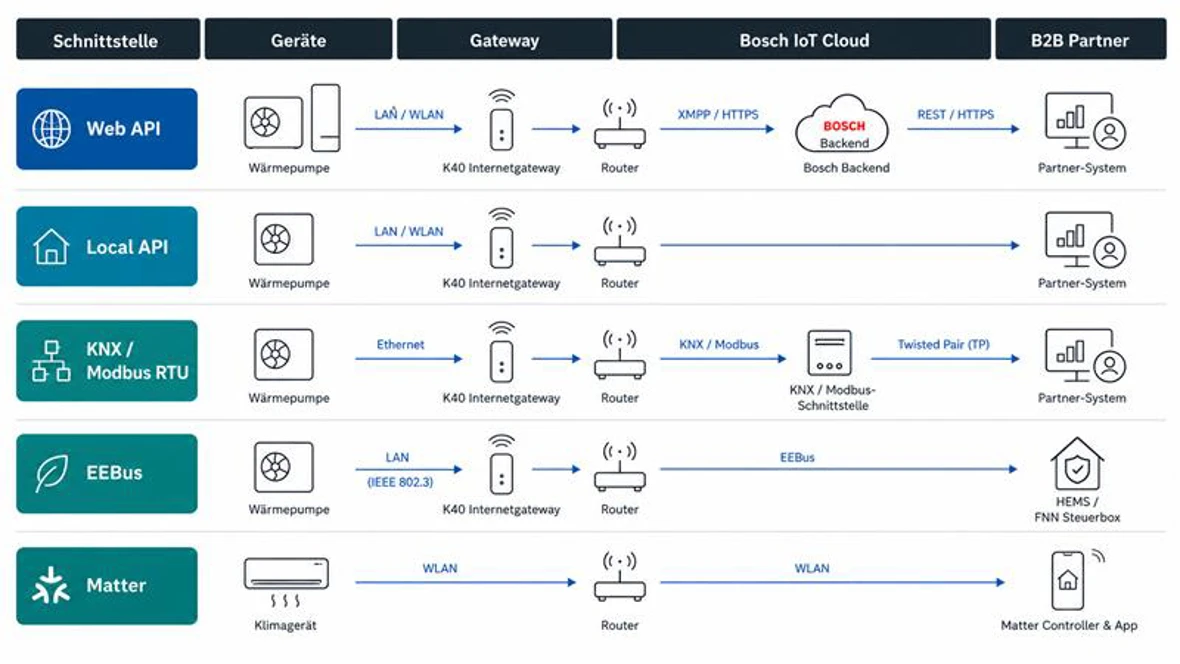
Bosch offers a variety of interfaces for different target groups and use cases. These include solutions for end customers as well as professional interfaces for specialist partners, integrators, and developers.
For End Customers
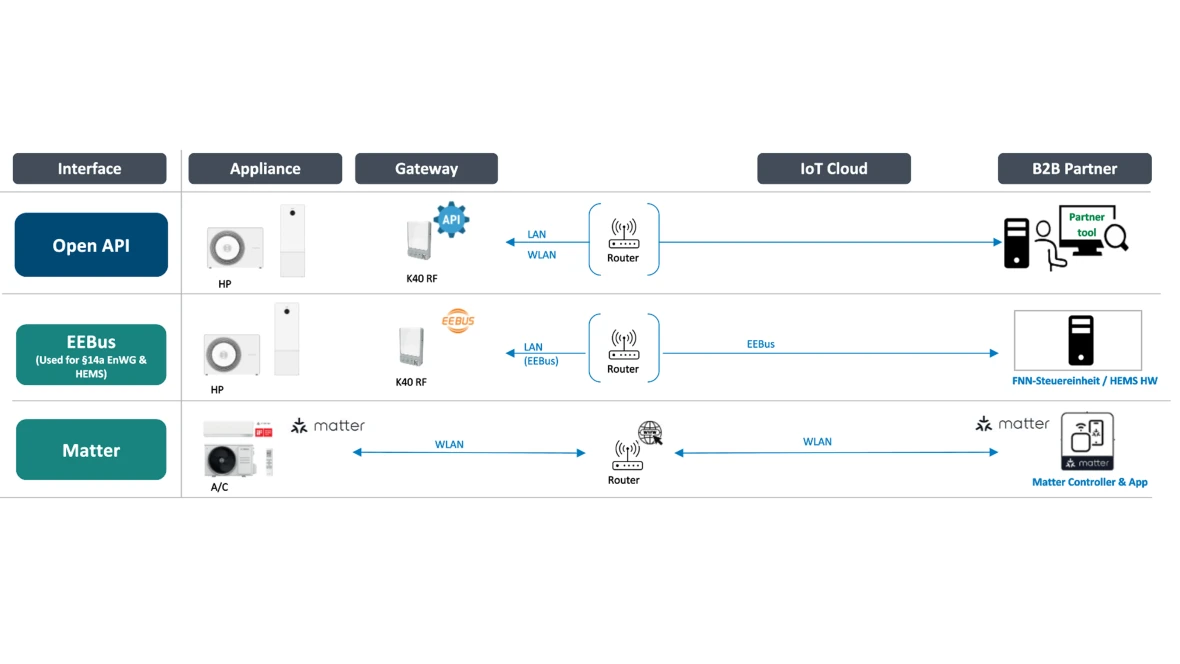
Interfaces such as Open API, EEBus, and Matter are available for integration into energy and smart home systems. They enable convenient networking of devices and create the foundation for intelligent applications in the home.
For Specialist Customers
For technically demanding integrations, Bosch offers professional interfaces such as Local API, Cloud REST API, KNX, and Modbus RTU. These are suitable for applications where systems need to be deeply integrated, data needs to be further processed, or functions need to be incorporated into higher-level platforms.
With this interface portfolio, Bosch supports both simple networking solutions and complex integrations into energy, building, and management systems.
Are you interested in our interfaces?

Then contact us
For any questions regarding our interfaces, please feel free to contact us:
hcpartnermanagement@de.bosch.com







For professionals: Overview and technical requirements
For end customers: Overview and technical requirements
API
What is an API interface?
An API interface is a standardized connection that allows different software applications, devices, and platforms to communicate with each other. It defines how data is requested, transferred, and processed. For developers, APIs are a central foundation for system integration. They enable the automated provision of information, the use of functions from other systems, and the efficient linking of applications. API interfaces thus create the technical basis for integrating devices, software solutions, and digital services into existing systems and for reliably exchanging data.
What API interfaces does Bosch offer?
Bosch offers both a web and a local REST API.
Local APIs are available directly on a device or within a closed network. They are suitable for applications where systems are connected locally and data is processed directly on-site.
Web APIs are accessible via the internet. They enable the connection of external applications, platforms, and cloud services. This allows data to be retrieved regardless of location and functions to be flexibly integrated into higher-level systems.
Partner Web API
Description
Description
The Web REST API is suitable for scalable, networked applications that integrate device and system data across different platforms – perfect for specialist partners, platform providers, or complex service solutions.
Features:
- Accessible via the internet: Devices only need to be online – no additional on-site hardware is required.
- Easy implementation: A unified interface for various device types thanks to abstraction of complexity.
- Advanced functionality: Access to web-based features such as data analytics, pricing tables, and more.
- Rapid updates: New features and improvements can be deployed centrally.
- Reduced integration effort: Less effort compared to on-premises solutions.
- Efficient data delivery: Event-driven communication via webhooks.
- Partner program: We support you with your integration.
- Ongoing costs and annual fees
Supported Use Cases
Supported Use Cases
Remote Commissioning & Parameterization
- Remote access to devices during commissioning and for optimization
- System Optimization
Monitoring & Service
- Remote monitoring for trouble-free operation with error messages
- Remote access for troubleshooting and maintenance
- Scheduling of service visits
Energy Management
- Energy consumption monitoring
- Optimization of self-consumption of PV power
Requirements
Requirements
1. Heat Generator
2. K30/K40 Gateway
3. Access to Bosch HomeCom Pro
4. Your own backend on the partner's website
Compatible Heat Generators
Compatible Heat Generators
- All Bosch heat pumps in combination with Internet Gateway K30 RF or K40 RF
- All Bosch gas and oil heat generators in combination with Internet Gateway K21 RF, K30 RF, or K40 RF
Are you interested?
Are you interested?
For any questions regarding our interfaces, please feel free to contact us:
hcpartnermanagement@de.bosch.com
Partner Local API
Description and Benefits
Description and Benefits
The local REST API enables fast, stable, and internet-independent integration, ideal for professional applications, local energy management systems, and installers with high reliability requirements. Features:
- Available directly on a device or within a closed network – operates without a public internet connection.
- More resilient against service interruptions and attacks from the public internet.
- No ongoing costs
- Operation is possible even after gateway shutdown and E/O service.
- Partner Program: We support you with your integration.
Supported Use Cases
Supported Use Cases
Remote commissioning and parameterization
- Remote access to devices during commissioning and system optimization
- Remote commissioning and parameterization
Monitoring and Service
- Remote monitoring for trouble-free operation with error messages
- Remote access for troubleshooting and maintenance
- Scheduling service visits
- Error messages
Energy Management
- Energy consumption monitoring
- Optimization of self-consumption of PV power Heat pump control according to dynamic electricity tariffs
- Power limitation according to §14a EnWG (German Energy Industry Act)
Smart Home
- Time programs for heating and hot water
- Setting room temperature
- Temporary noise reduction of the heat pump “barbecue mode”
Requirements
Requirements
1. Air-to-water heat pumps
2. K40 Gateway
3. Exchange of (software) certificates for access
4. Hardware on the partner side Compatible heat generators
Compatible heat generators
Compatible heat generators
- Air-to-water heat pumps in combination with the K40 RF Internet Gateway
- CS 5(6)800 AW, CS 3800 AW, CS 8800 AW, Cascade
- Hybrid-ready and hybrid-integrated units with K40 RF
- C5800, 7800, 9800, CSH 5800
Are you interested?
Are you interested?
For any questions regarding our interfaces, please feel free to contact us:
hcpartnermanagement@de.bosch.com
Open Web API
Available at the end of the year
Description
Description
The Open Web API, designed as a REST API, is aimed at end customers who want to integrate their Bosch heat generator into private ecosystems, smart home systems, or IoT platforms (such as Home Assistant) via the internet. No advanced technical expertise is required.
Key Features:
Key Features:
- Accessible via the internet: Devices only need to be online – no additional on-site hardware is required.
- Fast updates: New features and improvements can be deployed centrally.
- Reduced integration effort: Lower complexity and effort compared to local solutions.
- No running costs: The Open Web API is provided to end customers free of charge.
Monitoring
Monitoring
- Direct access to system data via simple API calls.
- Seamless integration into personal smart home systems.
Controlling
Controlling
- Control capabilities through writeable data points (Write API).
- Ability to create automations within personal smart home systems.
Prerequisites
Prerequisites
- Heat generator
- K40 RF Gateway
Compatible Heat Generators
Compatible Heat Generators
All Bosch heat pumps in combination with the K40 RF Internet Gateway -> CS 5(6)800 AW, CS 3800 AW, CS 8800 AW, CS 7800 AW, CS 5801 AW
KNX
available from September 2026
What is KNX?
What is KNX?
- KNX is a globally recognized, open standard for the intelligent networking and automation of building technology.
- KNX enables a wide variety of devices and functions from different manufacturers to communicate with each other and be centrally controlled.
- KNX is extremely versatile and is used in private homes as well as commercial buildings such as offices, hotels, and hospitals.
Description
Description
- Robust and well-known protocol
- Easy to implement Vendor-independent, open standard with broad support
- High interoperability: Many certified devices available
- Energy efficiency: Optimized control saves energy
- No ongoing costs
Supported Use Cases
Supported Use Cases
Supported Use Cases
- Efficient, room-by-room temperature control. For example, the heating can be automatically turned down when no one is home or windows are open.
- KNX is playing an increasingly important role as a central hub for all energy flows within a building.
- Monitoring and optimization of energy consumption through the intelligent networking of consumers, power generators (e.g., photovoltaics), and storage systems.
- Integration of smoke detectors, window and door contacts, and alarm systems.
Use with Bosch heat pumps
Use with Bosch heat pumps
1. Air or brine-to-water heat pumps
2. K40 RF Internet Gateway
3. Bosch KNX 20 module
4. Customer-supplied/third-party hardware
Compatible heat pumps
Compatible heat pumps
Bosch heat pumps with K40 RF gateway: CS3800 AW, CS5800/6800 AW, CS5801 AW, CS8800 AW, CS7801 LW
Downloads for Bosch heat pumps
Downloads for Bosch heat pumps
Use with split air conditioning units
Use with split air conditioning units
- Split air conditioning unit
- Networking module MC R / MC R-1*
- *only for CL3000i/CL3200i/CL6000i/CL7000i, not required for Light Commercial units
- Compatible third-party KNX module (provided by the customer) from Intesis
- Customer-provided/third-party hardware
Compatible split air conditioning units
Compatible split air conditioning units
CL3000i/CL3200i and CL7000i with MC R, CL6000i with MC R-1, split air conditioning units with Light Commercial indoor unit 4CC, 4C, CF, CN, D
Downloads for split-system air conditioners
Downloads for split-system air conditioners
Modbus RTU
available from January 2027
General Information
General Information
Modbus RTU is a widely used industrial communication protocol for serial data transmission between devices. It belongs to the Modbus family of protocols, which were originally developed for automation. Data is transmitted in a compact binary format, making communication fast and efficient.
Description
Description
- Robust and well-known protocol
- Easy to implement
- Potentially large number of data points
- No certification required
- No security issues, as only 2 local lines are used
- No ongoing costs
Supported Use Cases
Supported Use Cases
Remote Parameterization
- Remote access to devices during commissioning and system optimization
- Remote system optimization during operation
Monitoring & Service
- Remote monitoring for trouble-free operation with error messages
- Remote access for troubleshooting and maintenance Scheduling of service visits
- Error messages
Energy Management
- Monitoring of energy consumption
- Optimization of self-consumption of PV power
- Heat pump control according to dynamic electricity tariffs
Use with Bosch heat pumps
Use with Bosch heat pumps
Requirements
1. Air-source and brine-to-water heat pumps
2. Internet Gateway K40 RF
3. Bosch Modbus 20 module (RTU)
4. Customer-side/3rd-party hardware
Compatible heat pumps
Compatible heat pumps
Bosch heat pumps with Gateway K40 RF: CS3800 AW, CS5800/6800 AW, CS5801 AW, CS8800 AW, CS7801 LW
Downloads for Bosch heat pumps
Downloads for Bosch heat pumps
Use with split air conditioning units
Use with split air conditioning units
CL3000iCL3200i and CL7000i with MC R, CL6000i with MC R-1, split air conditioning units with light commercial indoor unit 4CC,4C, CF,CN, D
Downloads for Bosch split-system air conditioners
Downloads for Bosch split-system air conditioners
Open Local API
available from September 2026
Description
Description
- The Open local API is a modern and user-friendly REST interface for end customers and smart home providers who want to query a heating system's data points via a local interface. It also complies with Regulation (EU) 2023/2854 on harmonised rules on fair access to and use of data (Data Act).
Features:
- Available directly on the device or within a closed network—operates without the public internet
- No ongoing costs
- Query system data points via a simple, local interface
Supported Use Cases
Supported Use Cases
Monitoring
- Direct access to system data via a simple API call
- Option to integrate into custom home systems
Prerequisite
Prerequisite
1. Heat generator
2. K40 RF/ K21 Gateway
Compatible heat pumps
Compatible heat pumps
• All Bosch heat pumps in combination with Internet Gateway K40 RF – CS 5(6)800 AW, CS 3800 AW, CS 8800 AW, CS 7800 AW, CS 5801 AW
• All Bosch gas boilers in combination with Internet Gateway K40 RF or K21
Download
Download
EEBus
General Information
General Information
What is EEBus?
EEBus is a communication protocol focused on energy management applications for major appliances, heating and ventilation systems, and electromobility. It enables intelligent communication between household appliances, electric vehicles, heat pumps, energy generators, storage systems, energy management systems (EMS), and the smart meter gateway. EEBus acts as a common language that connects a wide variety of electrical building components across different sectors.
Description
Description
EEBUS communication takes place over a network, whether wired or via Wi-Fi. Typically, a central Home Energy Management System (HEMS) communicates via EEBUS with all connected components, such as the heat pump, wallbox, or smart meter gateway. Alternatively, EEBUS-enabled devices can communicate directly with the smart meter gateway to implement power limitations in accordance with Section 14a. Particular emphasis is placed on IT security to prevent unauthorized access. EEBUS is based on defined use cases that govern data exchange between various components and specify the behavior of participants in specific scenarios. One example is power limitation under Section 14a (LPC).
A detailed overview of the use cases can be found on the EEBUS website.
Use cases supported by Bosch
Use cases supported by Bosch
Power Limitation (LPC)
- Objective: Protection of local grid stability
Mechanism: Ensuring the heat pump complies with the power limitation value received from the smart meter gateway (SMGW) or a third-party EMS (LPC takes priority over comfort)
Power Monitoring (MPC)
- Objective: Transparency regarding electricity generation and consumption
Mechanism:Forwarding the heat pump's electricity consumption value to the Smart Meter Gateway (SMGW) or a third-party Energy Management System (EMS)
Optimization of PV self-consumption (OHPCF)
- Objective: Optimization of PV self-consumption using the heat pump
Mechanism: Transmission of a power sequence to the EMS, which controls the available flexibility (based on PV surplus)
Prerequisites
Prerequisites
1. Air-source and brine-to-water heat pumps and hybrids
2. Internet Gateway K40 RF
3. FNN control unit / hardware provided by partner
Compatible heat generators
Compatible heat generators
Heat pumps
-
CS 7001i/ 7400i AW
Outdoor unit
v01.22 System controller from version
HPC 400, NF 73.06 Supported use cases
Curtailment pursuant to Section 14a EnWG (LPC, MPC)
-
CS 5(6)800i AW
Outdoor unit
v07.10 System controller from version
UI 800, NF 47.09 Supported use cases
Curtailment pursuant to Section 14a EnWG (LPC, MPC) and PV self-consumption optimization (OHPCF)
-
CS7800i LW
Outdoor unit
v03.06 System controller from version
UI 800, NF 47.09 Supported use cases
Curtailment pursuant to Section 14a EnWG (LPC, MPC)
-
CS3400i AW
Outdoor unit
v02.03 System controller from version
HPC 400, NF 73.06 Supported use cases
Curtailment pursuant to Section 14a EnWG (LPC, MPC)
-
CS3800i AW
Supported use cases
Curtailment pursuant to Section 14a EnWG (LPC, MPC) and PV self-consumption optimization (OHPCF)
-
CS8800i AW
Supported use cases
Curtailment pursuant to Section 14a EnWG (LPC, MPC) and PV self-consumption optimization (OHPCF)
-
Kaskade
Supported use cases
Curtailment pursuant to Section 14a EnWG (LPC, MPC) and PV self-consumption optimization (OHPCF)
Hybrid systems
-
Hybrid package with Bosch Hybrid Manager
Outdoor unit (from version)
v06.06 System controller from version
CW 400, NF 47.06 Supported use cases Curtailment pursuant to Section 14a EnWG (LPC, MPC) -
Hybrid package with Bosch Hybrid Manager
Outdoor unit (from version)
v06.06 System controller from version
UI 800, NF 49.09 Supported use cases Curtailment pursuant to Section 14a EnWG (LPC, MPC)
Commissioning
Commissioning
Matter
General Information
General Information
Matter is the open, cross-manufacturer connectivity standard for the connected home—developed and supported by over 600 companies, including Apple, Google, Amazon, Samsung, and Bosch. It ensures that devices from different manufacturers communicate reliably with one another, whether the focus is on convenience, security, or energy efficiency.
Description
Description
- One standard, many devices – Whether it’s lighting, sensors, wallboxes, heat pumps, or solar systems: Matter-certified devices speak the same language and work together seamlessly.
- Smart energy management – Matter enables holistic control of household energy flows: solar systems, battery storage, heat pumps, water heaters, and EV charging stations coordinate automatically—based on electricity prices, self-consumption, and grid load.
- Simple setup – Scan the QR code, connect the device, and you’re done. No need for separate apps or accounts for each manufacturer. Platform freedom – Control all Matter devices via the platform of your choice—Apple Home, Google Home, Amazon Alexa, or specialized home energy management systems (HEMS).
- Security & privacy – Encryption and local data processing are built into the standard. Your data stays in your home.
- Future-proof – Matter is continuously evolving and already supports use cases such as vehicle-to-grid (V2G), dynamic electricity tariffs, and CO₂-optimized consumption.
Supported use cases
Supported use cases
Lighting & Switches – Lamps, dimmers, push-buttons, power outlets
Security – Door locks, contact sensors, smoke & CO detectors, cameras
Shading & Coverings – Roller shutters, blinds, awnings
Climate & Indoor Comfort – Thermostats, air conditioners, air purifiers, fans
Energy Management – Solar systems, battery storage, heat pumps, wallboxes, dynamic electricity tariffs
Sensors – Temperature, humidity, air quality, presence, water leak, and much more
Appliances – Refrigerator, washing machine, dishwasher, oven, robot vacuum
Media – Speakers, video players, remote controls
Requirements
Requirements
A Wi-Fi network – Matter communicates via your existing home network (Wi-Fi or Ethernet).
A smartphone or tablet – For setup via QR code (iOS or Android).
A compatible control hub (controller) – e.g., an Apple HomePod, Amazon Echo, Google Nest Hub, or a specialized energy management system. The controller manages your devices and enables automation. The good news: control hubs are increasingly integrated into devices you may already have at home—such as smart TVs, speakers, or Wi-Fi routers. The number of such devices is constantly growing.
For Thread devices: a Thread Border Router – This is already integrated into many current controllers.
Compatible heat generators
Compatible heat generators
- Bosch air purifiers: Air 2000i, Air 4000i, and Air 6000i
- Single-split air conditioners: Climate 7000i